Stéphane Schuck
Founder · Physician · Public Health Expert
Clinical and public health leadership anchoring Ultima-i in medical seriousness, epidemiology and health-system relevance.
Ultima-i sits at the intersection of medicine, public health, data science and applied artificial intelligence. The company is designed to help organisations move from complexity to usable health intelligence.
Ultima-i brings together physicians, public health experts, pharma specialists, data infrastructure leaders and AI engineers to solve health questions with more precision. That combination helps teams move faster without losing scientific discipline, readability or practical relevance.

Health organisations do not need abstract AI promises. They need tools and programmes that make complex data easier to understand, generate and operationalise.
We believe better systems should improve decision quality without becoming opaque. The objective is not more technical noise, but clearer evidence, better products and more usable intelligence.
Ultima-i was formed around a simple idea: health AI becomes more valuable when medicine, public health, rigorous methods and product execution are designed together from the start.
Ultima-i works alongside hospital, research, industry and innovation partners on programmes where medical depth, operational clarity and AI execution need to move together.
Each engagement is framed through domain understanding, scientific method and delivery discipline so the outcome remains useful beyond the prototype stage.
A multidisciplinary team combining medical evaluation, public health, scientific operations, data strategy and generative AI execution.
Founder · Physician · Public Health Expert
Clinical and public health leadership anchoring Ultima-i in medical seriousness, epidemiology and health-system relevance.

Data Strategy · Ecosystem Leadership · HPC Infrastructure
Bridges commercial execution and technical depth across AI, data sovereignty and high-performance computing, with three decades of ecosystem building.

AI Expert · Data Science
Leads advanced modelling, AI structuring and technical translation between scientific ambition and usable systems.

AI Engineer
Develops generative and predictive AI workflows, with a focus on health data usability, structured outputs and product implementation.
Our collaborations span academic research, hospital ecosystems, pharmaceutical programmes, data science and innovation funding. Each partnership reinforces the same objective: making health data more actionable.




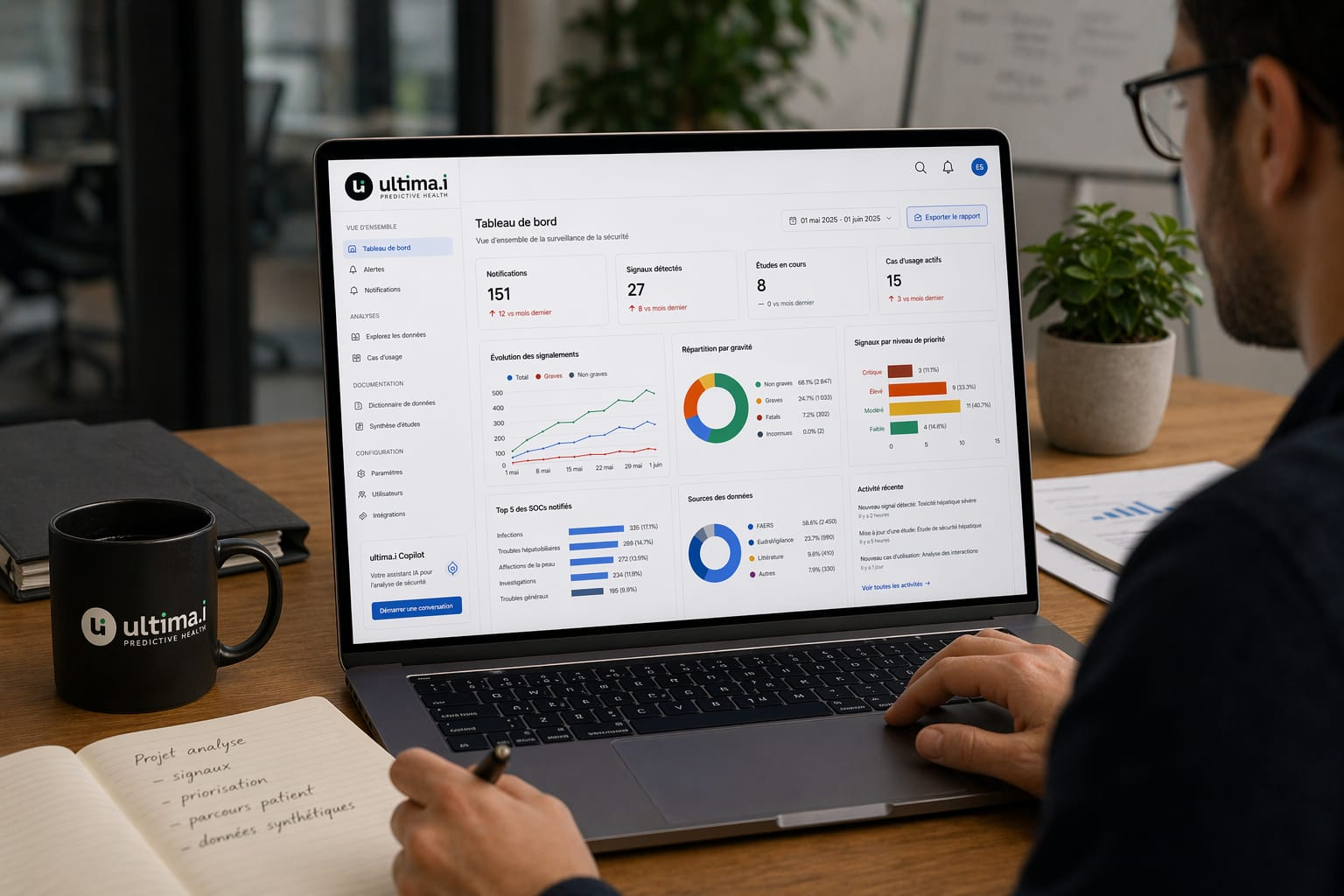
Ultima is a modular data visualisation and management platform built to adapt to any medical or health environment: hospitals, research programmes, pharma, public health and beyond. The image below is one example of what it can become.
The platform transforms dense, heterogeneous health data into structured dashboards and visual environments that give teams a clear, operational picture of what matters, adapted to the clinical or scientific context of each client.
Beyond visualisation, Ultima provides a structured environment to manage cases, studies, use cases and workflows, with full traceability, team collaboration and governance designed for medical and scientific environments.
Ultima Copilot is not a separate tool. It an AI assistant embedded natively inside the platform that understands the health context you are working in, supports analysis and helps teams act faster without leaving their environment.
Ultima is not a fixed product. It is a core platform that Ultima-i configures, adapts and deploys around the specific needs of each organisation: whether that is a hospital monitoring patient trajectories, a pharma team managing safety signals, a research unit tracking study progress or a public health programme analysing population-level data.
All data, analysis, cases and team activity live in one environment, with no fragmented tools and no context switching.
Every interface and workflow is designed with domain understanding, not just data engineering, but health logic.
Ultima Copilot is embedded at the core, available in context, without leaving the workspace, without additional setup.
Each deployment is configured around client needs, covering the modules, views and workflows that matter for that specific programme.
Interpret clinical language, longitudinal signals and large-scale health data with medical context, evidence and operational clarity.

Generate synthetic data, structured outputs and new research material under medical and scientific constraints.

Design interpretable predictive systems for trajectories, next events and decision support where timing and action matter.
The examples below show the type of work Ultima-i is building today across health data, generation and prediction.

Ultima-i projects often start with dense clinical or real-world complexity, then move toward tools, models and workflows people can act on.
Even when the work is large scale, the final objective remains concrete: clearer reasoning, better timing and more useful decisions for real patients.
A safety intelligence environment designed to help teams review information faster, prioritise the right signals and coordinate action more clearly.
SIDARTA is developed in collaboration with a major pharmaceutical industry player. It is designed as a workspace for pharmacovigilance and safety teams facing large volumes of information, multiple viewpoints and constant pressure for consistency.
Make safety review less fragmented across people, risks, patient profiles and decision timelines.
Interactive risk views, patient-level reasoning, key risk analysis, probability trees and embedded AI assistance.
Better visibility, clearer prioritisation and a stronger bridge between analysis and action.
An end-to-end programme for patients with ciliopathies, combining understanding, generation and prediction in one medical workflow.
Silico is developed in collaboration with Institut Imagine and AP-HP. It is designed to support a demanding clinical objective: better understand the disease, generate the right data assets and identify the most relevant timing to administer a treatment.
Clarify complex disease mechanisms and patient patterns in a context where timing matters clinically.
Combined disease understanding, targeted data generation and predictive modelling around treatment timing.
A more informed path toward clinically useful decisions for patients affected by ciliopathies.
A synthetic health data initiative designed to generate credible, useful and privacy-conscious datasets for experimentation and development.
SYNTHIA focuses on the practical value of synthetic data in health contexts where access, privacy or scarcity can limit exploration. The goal is not artificial volume for its own sake, but data that can support better testing, better models and better scientific workflows.
Access realistic health data assets without exposing sensitive information or waiting for impossible collection conditions.
Controlled synthetic data generation with strong attention to quality, utility and downstream evaluation.
Faster experimentation, safer exploration and more room to design and test health AI systems.
A project focused on patient trajectories, temporal structure and the interpretation of complex longitudinal health data.
This work addresses one of the hardest realities in health data: value often sits in the sequence, not only in isolated variables. Ultima-i uses that longitudinal logic to make trajectories more readable, comparable and actionable.
Understand how events unfold over time rather than analysing health data as disconnected snapshots.
Temporal structuring, trajectory analysis and modelling approaches aligned with real patient histories.
More faithful interpretation of patient journeys and stronger foundations for downstream prediction.
A predictive modelling effort designed to anticipate the next clinically relevant event from patient history and structured context.
This project explores how fine-tuned models can capture sequential logic in health data and turn it into useful predictive support. It is particularly relevant when the next event matters for care planning, follow-up or operational decisions.
Anticipate what is most likely to happen next in a sequence of clinical or patient events.
Fine-tuned predictive models built around temporal health data and clinically meaningful event definitions.
More proactive workflows, clearer anticipation and stronger decision support across complex patient pathways.
Ultima-i is best suited to conversations where medical seriousness, technical depth and strategic clarity all matter at once.